

To help children develop empathy, learn situational awareness, and understand how to stay safe around dogs by observing their body language and understanding the importance of looking out for their dog.
The Detective’s Mindset
Start by framing the session. Explain that dogs have their
own secret language, and as Dog Detectives, it is their job to translate it.
· The
Whole-Body Rule: Remind the group that a tail wag does not always mean ‘I am
happy.’ Just like a human might smile when they are nervous, a tail can wag
when a dog is scared or feeling conflicted. We must look at the eyes, ears,
mouth, body tension as well as the environment to get the full story.
· Whispers vs. Shouts: Introduce the concept that dogs give ‘whispers’ (subtle signs) long before they ever need to ‘shout’ (growl, snap, or bite). Good detectives spot the whispers so they can act kindly and avoid the shouts from their dog.
The Detective’s Observation Wall
Create a visual gallery and discuss what each clue tells us.
· The
Happy/Wiggly Clues:
o Soft
eyes
o Mouth slightly open with the tongue out
o Loose body, hips moving with the tail.
· The
I’m Unsure/Need Space Clues:
o The
Paw Lift: A holding position that says, ‘I am pausing to think.’
o The
Whale Eye: Showing the whites of the eyes, often with a worried brow.
o The Lip Lick/Yawn: These are ‘calming signals’ used to lower stress.
o Turning Away: The most polite way a dog can say, ‘I am choosing not to engage with this situation.’
· The
Warning/Stay Back Clues:
o Body
stiff like a board
o Mouth
tightly closed
o Ears
pinned back against the head
o Tail
tucked low.
Interactive Exercises
‘Detective's Simulation’ (The Acting Game)
The staff acts out a scenario (or shows a photo) and the
children must ‘investigate.’
- Example:
Staff stands stiffly, eyes wide (whale eye), and turns away.
- Children’s Task: Shout out what the ‘dog’ is feeling (scared/stressed) and what the correct ‘Detective Action’ is (e.g. ‘Give them space!’).
The ‘Greeting’ Challenge
Teach the children the ‘Tree and Statue’ technique:
- The
Tree: If a dog is excited or coming towards you, be a ‘Tree.’ Stand still,
hands tucked in, eyes looking down at your feet. Being a ‘Tree’ tells the
dog you are not a threat and not an invitation to jump.
- The Statue: If you are already engaging, be a ‘Statue.’ Keep your body still and quiet. If the dog moves away, you stay like a ‘Statue.’ Never chase a dog who is trying to leave!
Deepening the Context
Help children understand that location matters.
- The Home
Zone versus the Park Zone: Discuss how a dog might act differently when
they are eating, sleeping, or in a new place.
- Ask the Children: ‘If your dog is sleeping in their bed and you want to play, what should you do?’ (Answer: Let them sleep! Even a happy dog can be grumpy, in particular if they are startled).
Detective's Ethics and Safety
Summarise the core responsibilities of a Dog Detective.
- The Ask
First Rule: Always ask the owner and the dog. If the dog turns
their head away when you ask to pet them, they are saying ‘no thanks,’ and
that is a perfectly fine answer!
- Advocacy:
If you see a friend bothering a dog who is showing ‘whispers’ (lip
licking, whale eye etc.), gently tell your friend, ‘I think the dog needs
a break,’ and walk away together.
- Report, Don't React: If you see a dog that looks very stressed or seems like they might ‘shout’ (growling, snapping), do not try to fix it. Move away calmly and tell an adult immediately.
Tips for the Staff
- Model
the Behaviour: When you show a ‘stressed’ signal, don't make it scary, make
it a learning moment about respect.
- Use
Props: Use a plush dog toy to demonstrate where to pet (the chest or side,
never on the top of the head) and how to approach (from the side, never face-to-face).
- Keep it Positive: Emphasise that being a detective is about protecting our dog friends so we can have a safer, closer bond with them.

Out and About Activity
This activity requires you to create a map, and set up a trail in your own surroundings. We have provided the 6 posters (download below) that can be printed on A4 paper to be laminated and hung up. The map has to be created by yourself, as we don't know your location! Have fun and enjoy the excitement from your 'dog detective' participants.
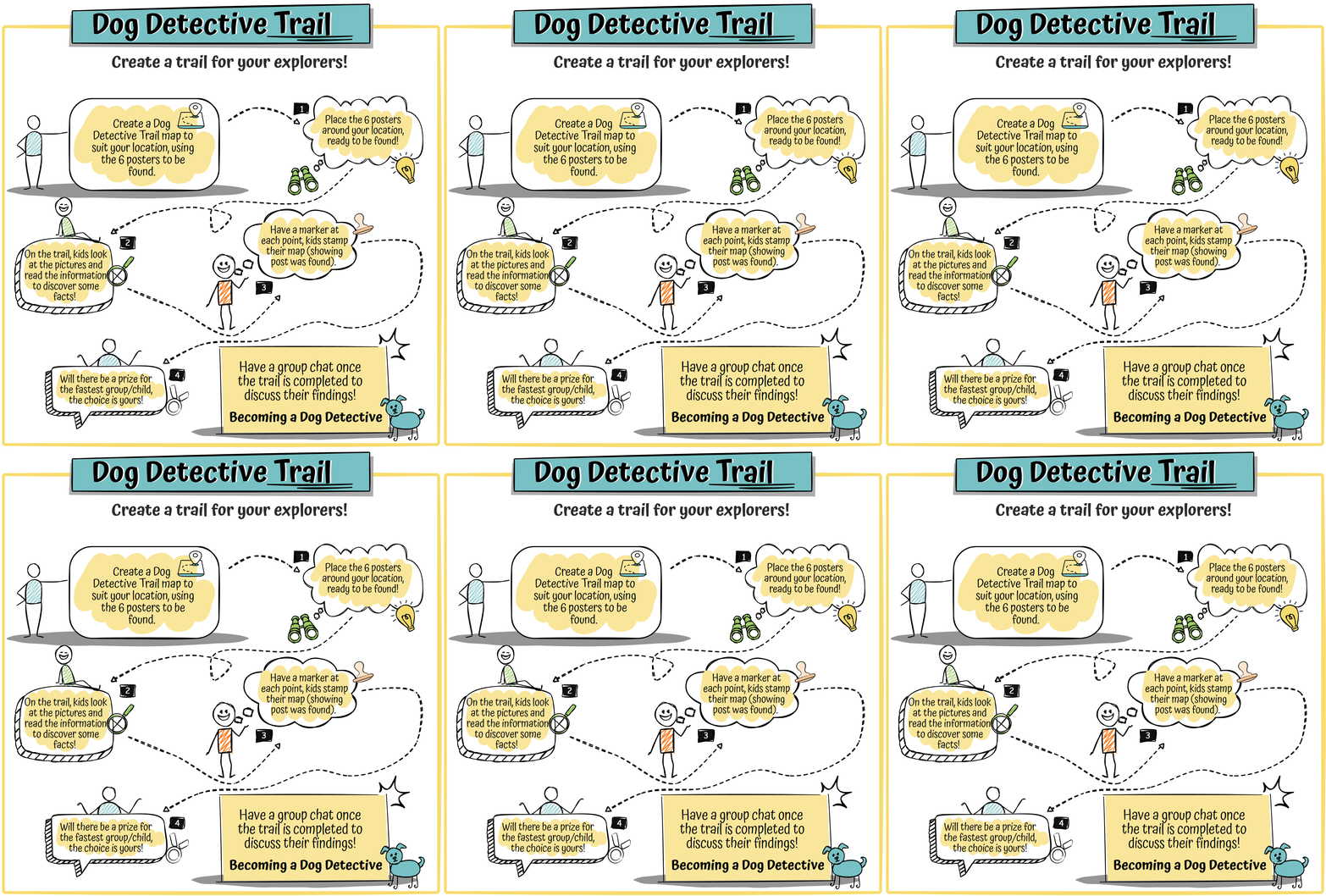
The posters for the Dog Detective Trail
These 6 posters are ready for you to print, laminate and hang up around your trail. Remember to make your own map!
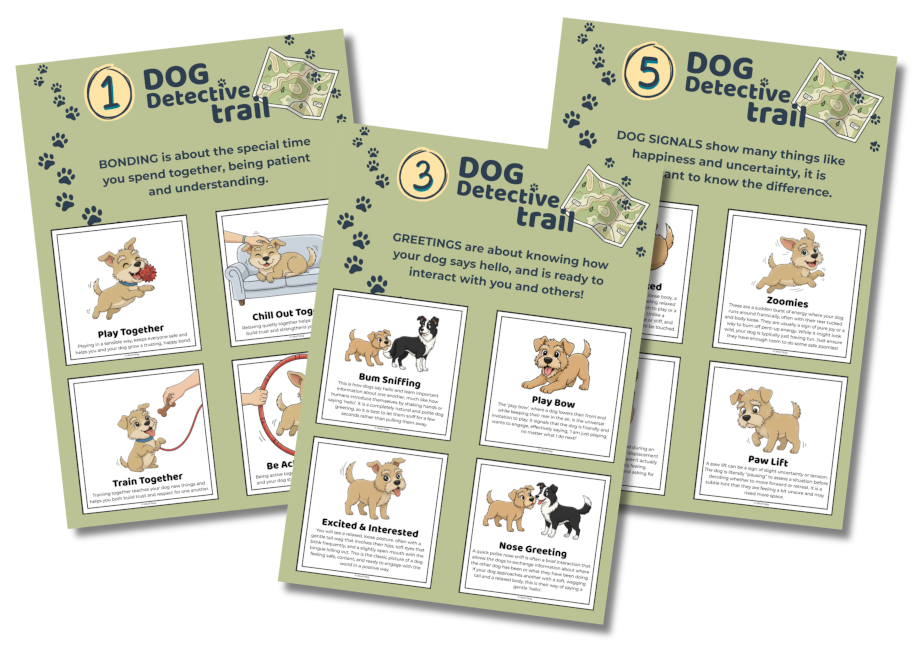
Click image to download a PDF version of the posters, save to your electronic device, ready for printing and hanging up! (Please note that the PDF file is big as it has 6 posters in it, so it takes a few minutes to download).
Dog Detective Certificate
Please use this certificate if you wish to provide your group with proof of their participation. We all like to be reminded that we have done well, and this goes for both kids and dogs!
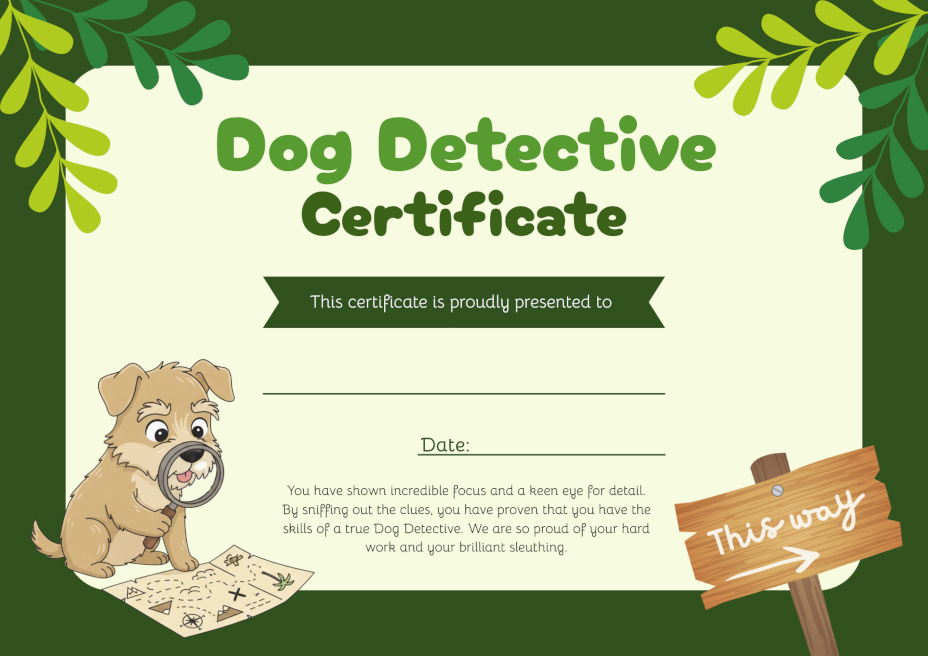
Click image to download a PDF version of the certificate, save to your electronic device, ready for printing.